
Main CPGW Record
Surname: NOBLE
Forename(s): Anthony
Place of Birth: Bampton, Westmorland
Service No: 5151
Rank: Rifleman
Regiment / Corps / Service: King’s Royal Rifle Corps
Battalion / Unit: 2nd Battalion
Division: 1st Division
Age: 31
Date of Death: 1915-05-31
Awards: ---
CWGC Grave / Memorial Reference: II. C. 16.
CWGC Cemetery: LILLERS COMMUNAL CEMETERY
CWGC Memorial: ---
Non-CWGC Burial: ---
Local War Memorial: INGLETON, YORKSHIRE
Additional Information:
Anthony Noble was the son of John and Frances Noble, née Davis. Frances was born at Little Asby, Westmorland.
1891 Toathmain, Shap, Westmorland Census: Good Croft - Antony Noble, aged 6 years, born Bampton, Westmorland, son of Frances Noble, widow.
1901 Newbiggin, Cumberland Census: Anthony Noble, aged 16 years, born Bampton, Westmorland. [Anthony was employed by Mark Walker, Farmer.]
Anthony was married to Eleanor Taylor in 1908.
1911 Masongill, Yorkshire Census: Anthony Noble, aged 25 years, born Bampton Grange, husband of Eleanor Noble.
The British Army Service Record for Anthony Noble exists but may be incomplete.
British Army WW1 Medal Rolls Index Cards: Pte Anthony Noble, 5151, 2nd King's Royal Rifle Corps. Qualifying date [for 1914 Star]: 13 August 1914. Correspondence: Beech Terrace, Ingleton, Yorkshire.
A short biography of Anthony is included in: ‘The Ingleton War Memorial, 1914-18, 1939-45’ by Andrew Brooks (2005).
Data Source: Craven’s Part in the Great War - original CPGW book entry
View Entry in CPGW BookEntry in West Yorkshire Pioneer Illustrated War Record:
NOBLE, A., [Ingleton], K.R.R., killed in France in May, 1916.
---
Click the thumbnail below to view a larger image.
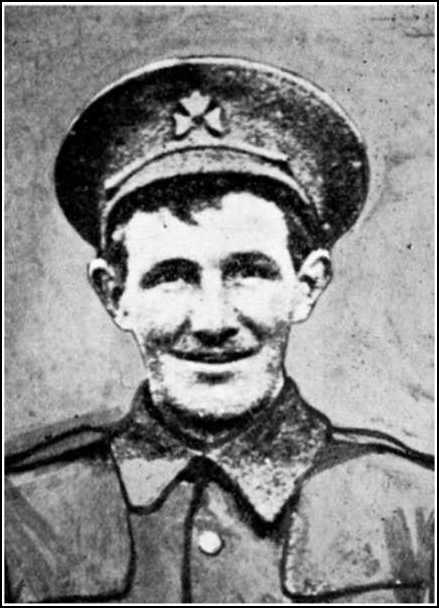
Rifleman Anthony NOBLE
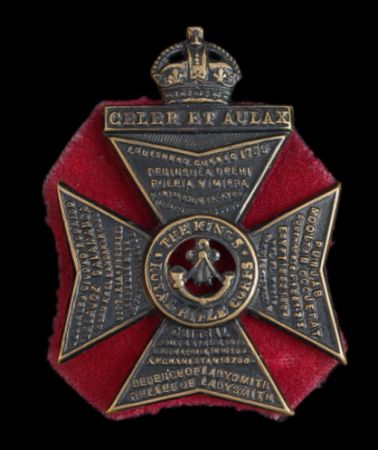
Regiment / Corps / Service Badge: King’s Royal Rifle Corps

Divisional Sign / Service Insignia: 1st Division
---
---
View Craven Herald Articles
View Craven Herald Articles

02 October 1914
INGLETONIANS AT THE FRONT
. . . Mrs. Noble, wife of Private A. Noble, has again heard from her husband, who has escaped being wounded up to the time of writing.
30 October 1914
JOTTINGS FROM INGLETON
Private Anthony Noble has been reported to be slightly wounded.
All the Ingleton Territorials, with the exception of three, have volunteered for foreign service.
Lance Sergt. W. Slinger has been promoted to the rank of Sergeant, and Private Joe Basker (Leeds Pals) to the rank of Lance Sergeant.
23 November 1914
INGLETON’S ROLL OF HONOUR
. . . Private Anthony Noble is an inmate of a hospital near Versailles, having been wounded in the face by shrapnel. Writing under date November 17th, he says he is improving though his eyesight is still weak.
11 June 1915
INGLETON – Ingleton And The War
The Ingleton Roll of Honour now contains the names of 148 persons.
On Tuesday Mrs. Noble, of Beech Terrace, received intimation that her husband, Private Anthony Noble, King’s Royal Rifles, had been killed in action. Private Noble was a Reservist, and was sent out to the Front when war broke out. Some time ago he was wounded by shrapnel, his face being much injured. Immediately on receipt of the news the flag at St. Mary’s Church was hoisted half-mast high.
01 October 1915
INGLETON – War Items
Private F. Hawcroft has been wounded, and is now in hospital at Birmingham.–Private J.T. Bradley has been home for 6 days on furlough, and has now returned to the Front.–Lance-Corporal Harry Atkinson, Royal Field Artillery, and Privates T. Heaps and E. Heaps have been spending a few days at home before being despatched to the Front.–The Ingleton Roll of Honour now contains the names of 154 persons. Of these, three have been killed, viz., Lieut. Gerald Kirk, Pte. A. Noble and Pte. E. Askew. The National School roll contains 98 names.
22 February 1918
INGLETON – IN MEMORY OF THE FALLEN
A memorial service for Ingleton men who have fallen in the war was held in St. Mary’s Church on Sunday evening. There was a large congregation, and the service was of an impressive character. The Union Jack was hoisted half-mast on the tower during the day. At the commencement of the service the organist, Mr. C. Bentham, played ‘O rest in the Lord’, and at the conclusion the Dead March in ‘Saul’, 'How bright these glorious spirits shine’, and other hymns appropriate to the occasion were sung, as was also the National Anthem. Standing on the Chancel steps, Bugler J. Robinson sounded the ‘Last Post’, and its solemn and eerie notes reverberated along the aisles.
Before commencing his address, the vicar, the Rev. D. T. Davies, read out the list of those who had fallen, as follows:–
Killed in action: Second-Lieutenant G. Kirk, Sergeant J. Metcalfe, Privates A. Noble, G. Scholey, C. Tomlinson, J. Smith, W. A. Hodgson, J. W. Wadeson, J. W. Robinson, J. Clapham, W. Smith, J. Schofield, J. Kettlewell, W. Marklew, E. Askew, P. Fletcher, G. Metcalfe, A. M. Booth, J. Woodhouse, W. Bolton, and J. [W.H.W.] Wilson.
Died in hospital: Privates W. H. Wignall and C. Newsholme.
Torpedoed: C. Grant.
Missing; Sergeant R. E. Walker, Privates A. Sherwin, W. Northey, E. Robinson, J. Saul, and W. [J.C.] Bradford.
The Vicar, speaking from the words, ‘Greater love hath no man than this, that a man lay down his life for his friends’, said that the occasion brought them face in face with a question that was momentous to everyone, and the list which he had just read made them pause and ask the question, “Is the cause for which we are fighting of such a nature that these sacrifices are necessary?” They must remind themselves of the causes which led to the war. Our honour was pledged to protect a small country from an oppressing wrong, and we were compelled to stand by them. They were standing to protect a weak country from a fearful wrong committed by one of the strongest nations in the world – from a military point of view the strongest – a nation that was steadily prospering year after year and which had been training its manhood to satisfy its mad ambition for power. It was becoming clear, especially during the last few weeks, that the dominant note running through their proposals had been their determination that might should conquer over right, and that they would rule as masters over the whole world. When they analysed the causes they saw that the principles of justice and righteousness were struggling against oppression and wrong-doing. They had seen an attempt to impose injustice on the whole world, to impose the doctrine that might is right and mercy unknown by the will of one man, and to sweep away religion, man’s guidance, in a moment.
View West Yorkshire Pioneer Articles
View West Yorkshire Pioneer Articles

09 October 1914
INGLETON WAR ITEMS
The churchwardens of St. Mary’s Church have put a Roll of Honour in the church porch, which contains the names of all those who have left the village to serve their country. The list, which is made up to the end of September, contains the names of 83 Ingletonians.
On Monday Messrs. Percy and Harold Howson, Norman Capstick, James Parrington, and William Robinson journeyed to Skipton to enlist. The first named, however, was rejected, he not coming up to military requirements.
Ingleton has now subscribed £170 to the Prince of Wales’ Fund and the Red Cross Association, and in addition to this the Ingleton women have sent to the Red Cross Association for soldiers, sailors and hospitals, 147 garments, 26 bandages, and 24 pocket handkerchiefs.
Mrs. Noble, the wife of Private A. Noble (who is in the fighting line), has heard from her husband that he has escaped being wounded up in the time of writing (September 29th).
Mr. and Mrs. S. Metcalfe, of Paradise Row, have received a communication from the War Office informing them that their son, Private Tom Metcalfe, of the King’s Own, has been wounded, and that he was in a French Military Hospital and was doing well. Private Metcalfe wrote home some three weeks ago informing his wife that he had been injured in the Battle of Mons, so that the War Office information is rather belated.
23 October 1914
INGLETON WAR ITEMS
Mrs. Noble, wife of Private Noble (who has been serving with the Expeditionary Force since the commencement of the war) has received notice that her husband has been slightly wounded. Mrs. Noble is very much puzzled, as she has had two post cards from her husband, since he was reported to have been wounded, the post cards stating that he is well.
04 December 1914
INGLETON WAR ITEMS
We are sorry to report that Private A. Noble is in hospital near Versailles, he having been wounded in the face with shrapnel, which it is feared will impair his eyesight.
11 June 1915
ANOTHER INGLETON MAN REPORTED KILLED
News has been received by Mrs. Noble of Beech Terrace, Ingleton, that her husband, Private A. Noble, of the King’s Royal Rifles, has been killed in France. The news came by letter from one of the men whom he was with in the trenches, but no other confirmation has been received at the time of writing. We understand that his death was caused by a hand grenade, but nothing authentic as to place or circumstances are yet known. Pte. Noble, who was a reservist, left Ingleton on August 6th, and went to France with the first Expeditionary Force, and although he has been reported wounded on two occasions, he had never been home since the war commenced. Much sympathy is felt with his wife and child, and as a token of respect the flag on St. Mary’s Church steeple was flying at half-mast.
24 December 1915
CRAVEN’S ROLL OF HONOUR – INGLETON
Pte. A. Noble, King’s Royal Rifles, killed in France in May. Left a wife and child, who reside at Ingleton.
22 February 1918
INGLETON
MEMORIAL SERVICE – On Sunday last a memorial service for the Ingleton soldiers who have fallen during the war was held in St. Mary’s Church. The flag on the tower was hoisted at half-mast. There was a very large congregation, and prior to the commencement of the service the organist (Mr. C. Bentham) played a solemn voluntary. The vicar (Rev. T. D. Davies) conducted the service, special prayers, psalms, and hymns being read and sung. The Vicar delivered a powerful sermon, taking as his text St. John, ch. 13 v., 13, “Greater love hath no man,” and prior to this read the following name of the Ingleton men killed and missing , some of whom have been presumed dead. The ‘Dead March’ was played at the close of the service, and the sounding of the ‘Last Post’ by Bugler J. Robinson concluded a solemn and impressive service. The following were the names read out by the vicar:–
Men killed: 2nd-Lieut. Gerald Kirk, Pte. A. Noble, Pte. G. Scholey, Sergt. Jas. Metcalfe, Pte. Cyril Tomlinson, Pte. James [Jabez] Smith, Pte. Wm. A. Hodgson, Pte. John W. Wadeson, Pte. John W. Robinson, Pte. Joe Clapham, Pte. Wm. Smith, Pte. Jas. Schofield, Pte. Jas. Kettlewell, Pte. W. Marklew, Pte. E Askew, Pte. Percy Fletcher, Pte. Geo. Metcalfe, Pte. A. M. Booth, Pte. J. Woodhouse, Pte. W. Bolton, Pte. J. [W.H.W.] Wilson; died in hospital: Pte. Chris. Newsholme, Pte. Henry Wignall; missing: Sergt Robert E. Walker, Pte. Alfred Sherwin. Pte. Wm. Northy, Pte. Jas. Saul, Pte. Ed. Robinson. Pte. W. [J.C.] Bradford; torpedoed: Charles Grant.
Comment on this Soldier Record
You can leave comments on this soldier record. Please note all comments will be manually approved before they appear on the website.


No comments yet.